


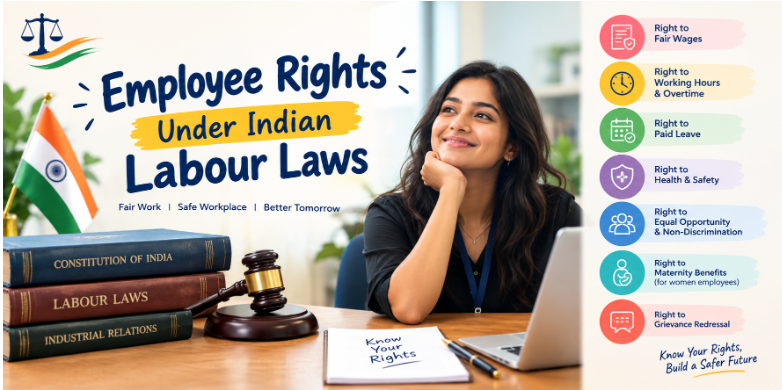
Introduction
Most employees sign an offer letter, start work, and rarely think about the legal protections backing their employment until something goes wrong. A delayed salary, an abrupt termination, or an unsafe workplace can quickly turn into a stressful situation, especially when employees aren’t sure what the law actually allows their employer to do.
Indian labour laws exist precisely to prevent this uncertainty. They set clear boundaries around wages, working hours, safety, termination, and workplace conduct, giving employees a legal foundation to stand on. Yet many employees remain unaware of these rights simply because the law isn’t explained to them in plain, practical terms—often making a timely lawyer consultation crucial for navigating complex workplace disputes effectively.
What Are Employee Rights Under Indian Labour Law?
Employee rights refer to the legal protections and entitlements granted to workers under various central and state labour legislations, covering areas such as wages, working conditions, social security, and termination procedures.
India’s labour law framework has traditionally been governed by multiple standalone laws, and is gradually being consolidated under four Labour Codes, covering wages, industrial relations, social security, and occupational safety. Employers are required to comply with applicable provisions regardless of business size, though certain thresholds determine which specific obligations apply.
Did You Know? Many employees are unaware that verbal assurances about salary, benefits, or job security carry little legal weight compared to what is documented in a signed employment contract or offer letter.
1. Right to Fair Wages
Employees are entitled to receive wages that meet or exceed the minimum wage prescribed by the state government for their category of work, paid within stipulated timelines.
This right is primarily protected under wage-related labour legislation, which mandates timely payment of wages and prohibits unauthorised deductions beyond what is legally permitted.
Aspect | Legal Protection |
Minimum Wage | State-notified minimum wage rates |
Payment Timeline | Wages must be paid within prescribed timelines |
Deductions | Only specific, legally permitted deductions allowed |
Equal Pay | Equal remuneration for equal work, irrespective of gender |
2. Right to Reasonable Working Hours and Overtime
Employees are entitled to defined working hours, weekly rest days, and additional compensation for work performed beyond standard hours.
Standard working hour limits are typically prescribed under state Shops and Establishment Acts and factory regulations, generally capping daily and weekly working hours, with overtime pay mandated for hours worked beyond this limit.
Practical insight: Employers who consistently require unpaid overtime, or fail to provide weekly rest days, may be in violation of these provisions, even if such practices are common in a particular industry.
3. Right to Leave and Holidays
Employees are generally entitled to earned leave, sick leave, casual leave, and public holidays, with specific entitlements varying by state legislation and company policy.
Common categories of leave include:
- Earned or privilege leave, accumulated based on service period
- Casual leave for short-term personal needs
- Sick leave for medical reasons
- Maternity leave under the Maternity Benefit Act
- Public and festival holidays as notified by the state
Common Mistake: Employees often assume unused leave automatically lapses at year-end, when many companies are required to allow carry-forward or encashment depending on applicable state rules and company policy.
4. Right to Social Security Benefits
What social security benefits are employees entitled to? Depending on eligibility criteria, employees are entitled to benefits such as Provident Fund, Employee State Insurance, and gratuity, aimed at providing financial security during and after employment.
Benefit | Applicable Law | Eligibility |
Provident Fund | Employees’ Provident Funds Act | Establishments with 20+ employees, subject to wage thresholds |
Employee State Insurance | ESI Act | Establishments with 10+ employees, subject to wage thresholds |
Gratuity | Payment of Gratuity Act | Employees completing 5+ years of continuous service |
5. Right to a Safe and Healthy Workplace
Employees are entitled to a safe working environment, free from hazards that could endanger their physical or mental well-being, with employers responsible for implementing necessary safety measures.
This obligation is particularly significant in industries involving physical labour, manufacturing, or hazardous materials, where occupational safety regulations require specific protective measures, training, and reporting mechanisms for workplace incidents.
Screenshot Suggestion: Include a screenshot from the relevant state Labour Department portal showing workplace safety compliance guidelines.
6. Right to Protection From Workplace Harassment
The Prevention of Sexual Harassment (POSH) Act, 2013 mandates that every organisation with 10 or more employees constitute an Internal Complaints Committee and provide a formal mechanism for reporting and addressing complaints of sexual harassment.
Key employee protections under POSH:
- Right to file a complaint without fear of retaliation
- Right to confidentiality during the inquiry process
- Right to interim relief, such as transfer or leave, during proceedings
- Right to a time-bound resolution of the complaint
Case Study: An employee who raises a harassment complaint is legally protected from retaliation such as demotion or termination linked to the complaint, and any such action taken by the employer can itself become grounds for legal action against the organisation.
7. Right to Protection Against Wrongful Termination
Employees cannot be terminated arbitrarily, particularly in industrial establishments, without following due process, including notice period, valid grounds, and in some cases, government approval for retrenchment.
Comparison: Termination vs Retrenchment
Feature | Termination | Retrenchment |
Reason | Individual performance, misconduct, or contract terms | Business reasons like downsizing or closure |
Process | Notice period or pay in lieu, as per contract | Notice, compensation, and in some cases government approval |
Applicable Law | Employment contract, Shops and Establishment Act | Industrial Disputes Act (now under Industrial Relations Code) |
Compensation | As per contract terms | Retrenchment compensation as prescribed by law |
Common Mistake: Employees often assume any termination without notice is automatically illegal, when in fact terms vary based on employment contract clauses, probation status, and applicable state legislation.
8. Right to Non-Discrimination
Employees are protected against discrimination based on gender, religion, caste, disability, or other protected characteristics, both in hiring and during employment.
This protection draws from constitutional guarantees of equality as well as specific labour legislation addressing equal remuneration and workplace conduct, reinforcing that employment decisions must be based on merit and performance rather than personal characteristics unrelated to the role.
9. Right to Association and Collective Bargaining
Employees have the right to form or join trade unions and engage in collective bargaining for better wages, working conditions, or dispute resolution, subject to applicable industrial relations laws.
This right is particularly relevant in larger industrial establishments, where collective bargaining often plays a significant role in negotiating wage revisions and working condition improvements.
What Should Employees Do If Their Rights Are Violated?
Process Flow — Steps to Address a Labour Law Violation:
- Document the issue with relevant evidence, such as emails, payslips, or written communication
- Raise the concern internally through HR or the appropriate grievance mechanism
- Refer to the employment contract and applicable company policy
- Consult a labour lawyer to assess legal options
- File a formal complaint with the relevant labour authority or Internal Complaints Committee, where applicable
- Pursue legal remedy through the appropriate forum if internal resolution fails
Common Mistakes Employees Make Regarding Their Rights
- Not reading the employment contract carefully before signing
- Assuming verbal promises hold the same weight as written terms
- Delaying action on wage or benefit disputes, allowing evidence to become harder to establish
- Not documenting workplace incidents or communications
- Being unaware of applicable state-specific labour law variations
- Hesitating to seek legal advice due to fear of employer retaliation
Conclusion
Employee rights under Indian labour law cover far more than just salary and leave, extending to safety, dignity, fair treatment, and protection against arbitrary employer action. Understanding these rights isn’t just useful when something goes wrong; it also helps employees recognise when their workplace is falling short of legal standards long before a dispute arises.
When in doubt, reviewing your employment contract and seeking timely legal guidance remains the most effective way to protect your interests as an employee.
Why Choose Zolvit
- Access to experienced labour and employment lawyers
- Support for both employees and employers navigating workplace disputes
- Fast, confidential consultation process
- Affordable, transparent pricing
- End-to-end support, from advice to legal representation
- Dedicated guidance tailored to your specific workplace situation
Get Started: If you believe your rights as an employee have been violated, don’t navigate it alone. Connect with Zolvit’s legal experts for Online Attorney Advice tailored to your situation.
Frequently Asked Questions
- Can an employer terminate an employee without any notice?
In most cases, employers are required to provide notice or pay in lieu of notice, as specified in the employment contract or applicable law. Termination without following due process may be challenged as wrongful, depending on the specific circumstances.
- Should every employee be covered under Provident Fund?
Not necessarily. Provident Fund coverage generally applies to establishments with 20 or more employees, subject to wage thresholds. Employees earning above a certain limit may have different applicability, so it depends on the specific establishment and salary structure.
- Can an employee file a harassment complaint anonymously?
Generally, no. The POSH Act requires a formal written complaint to initiate the inquiry process, though confidentiality of the complainant’s identity is maintained throughout the proceedings to protect against retaliation.
- Shall an employee always receive gratuity after resignation?
Gratuity is only payable to employees who have completed a minimum of five years of continuous service with the same employer, except in cases of death or disability, where this requirement may not apply.
- Can an employer deduct salary for unapproved leave?
YES. Employers can deduct salary for leave taken without approval or beyond the entitled leave balance, provided such deductions are consistent with company policy and applicable labour law provisions.