



INTRODUCTION: THE THRESHOLD OF JUDICIAL EVOLUTION
With these evocative words, Justice Sanjay Karol, speaking for a Division Bench alongside Justice N. Kotiswar Singh in Dr. Lokesh B.H. & Ors. v. State of Karnataka & Anr. (2026 INSC 784), dismantled a long-standing statutory fortress. For over four decades, Section 498A of the Indian Penal Code, 1860 (IPC) now codified as Section 85 of the Bharatiya Nyaya Sanhita, 2023 (BNS) remained stubbornly tethered to strict, literal interpretations of ceremonial marriage.
As a practitioner of criminal law, my analysis of this jurisprudence reveals that the Supreme Court did not merely expand a penal text; it rectified an enduring constitutional asymmetry. By bringing live-in relationships “in the nature of marriage” under the protective cover of Section 498A IPC / Section 85 BNS, the Court reconciled penal policy with Article 14 equality and advanced a modern framework of victimology.
I. THE CONSTITUTIONAL IMPERATIVE: ARTICLE 14 AND PURPOSIVE INTERPRETATION
The central legal debate in Dr. Lokesh B.H. turned on strict construction versus social-context interpretation. The defence contended that because Section 498A IPC is a penal statute penalising a “husband or his relatives,” it must be strictly confined to validly solemnised marriages.
To accept such a rigid plea would create what jurisprudence labels “legislative futility”. Denying criminal deterrence to a woman experiencing identical domestic trauma simply because her relationship lacks formal solemnisation fails the test of rational nexus under Article 14. Cruelty inflicts identical physical and psychological scars regardless of whether a ceremony occurred. The Bench rightly held that limiting criminal protection strictly to ceremonial wives, while leaving cohabiting women only with civil remedies under the Protection of Women from Domestic Violence Act, 2005 (PWDVA), creates an unconstitutional distinction.
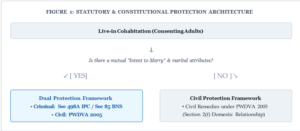
II. PENAL THRESHOLDS VS. CIVIL PROTECTIONS
From a victimological standpoint, civil remedies under the PWDVA (such as protection orders or maintenance under Section 2(f)) offer restitution, but lack the preventive leverage of state-enforced deterrence. However, expanding criminal liability requires careful boundaries to prevent overreach.
The Supreme Court drew a clear boundary: to attract criminal liability under Section 498A IPC / Section 85 BNS, the relationship must involve consenting adults and present a demonstrable “intent to marry”. This requirement preserves the principle of nulla poena sine lege by distinguishing transient cohabitation from stable, marriage-like bonds.
III. BALANCING PENOLOGY: DETERRENCE AND PROCEDURAL SAFEGUARDS
While expanding substantive criminal law to cover vulnerable victims, the Court also incorporated procedural checks. Addressing concerns regarding potential misuse or immediate custodial action, the Bench reaffirmed strict adherence to Arnesh Kumar v. State of Bihar (2014) 8 SCC 273. This dual approach ensures penal law serves its primary purpose: targeting genuine abuse while preventing procedural coercion.
IV. COMPARATIVE STATUTORY MAPPING
|
Legal Parameter |
Pre-Dr. Lokesh B.H. Framework |
Post-2026 Jurisprudential Position |
|
Statutory Sandbox |
Section 498A IPC (Strictly Ceremonial) |
Section 498A IPC / Section 85 BNS (Purposively Expanded) |
|
Protected Category |
Legally Wedded Wives Only |
Wives & Live-in Partners with “Intent to Marry” |
|
Constitutional Test |
Literal interpretation created an Article 14 anomaly |
Rational Nexus established via Social-Context Interpretation |
|
Threshold of Proof |
Proof of Valid Marriage / Formal Rites |
Proof of Cohabitation + Shared Intent to Formalise |
|
Arrest Protocol |
Variable compliance across jurisdictions |
Mandatory preliminary checks under Arnesh Kumar |
CONCLUSION: A MATURITY IN INDIAN PENOLOGY
Dr. Lokesh B.H. v. State of Karnataka reflects a maturing legal system. By looking beyond formal marriage criteria to address actual domestic harm, the Supreme Court aligned criminal jurisprudence with contemporary social realities.
As penal law transitions to the Bharatiya Nyaya Sanhita, this precedent reinforces a central principle of constitutional morality: the law’s protection against domestic cruelty depends on human dignity, not ceremony.